There are cities known for their history, cities known for their culture, and cities recognized for their natural beauty. Dubai belongs to a different category. Its identity is written across the horizon.
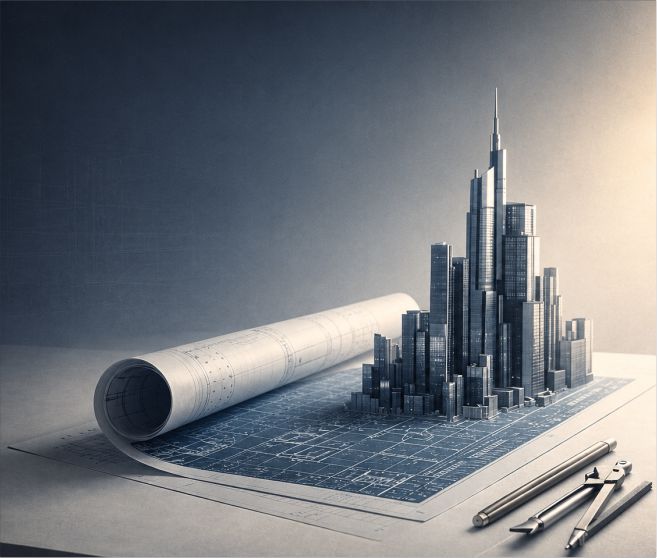
From the sail-shaped silhouette of Burj Al Arab to the extraordinary height of Burj Khalifa and the futuristic geometry of the Museum of the Future, Dubai has transformed its skyline into an architectural statement. The city’s buildings do more than occupy space. They compete for attention, create landmarks, attract investment, shape tourism, and communicate an unmistakable sense of possibility.
Dubai’s architectural transformation is particularly remarkable because much of its contemporary skyline emerged within a relatively short period. What was once a low-rise desert settlement has developed into a global metropolis where architecture plays a central role in defining the city’s international image.
From Functional Buildings to Global Landmarks
Dubai’s modern architectural story is closely connected to its rapid economic development. As the city expanded its role as a global center for business, tourism, trade, finance, and real estate, the demand for distinctive buildings grew alongside it.
Architecture became more than a practical requirement. It became part of the city’s strategy for establishing a global identity.
Few structures demonstrate this shift more clearly than Burj Al Arab. Designed in the form of a billowing sail and positioned on an artificial island, the hotel created a distinctive visual symbol for Dubai. Its unusual silhouette showed that a building could become an icon rather than simply a place to stay.
The same philosophy appeared on an even greater scale with Burj Khalifa.
Burj Khalifa: Engineering Height Into Identity
At 828 meters, Burj Khalifa remains the world’s tallest building. Its design came from Skidmore, Owings & Merrill, with architect Adrian Smith leading the architectural design and structural engineer William F. Baker contributing to its innovative structural system.
Yet its significance is not only measured in meters.
The tower’s Y-shaped floor plan and buttressed-core structural system allowed engineers to address the immense forces created by its extraordinary height. Instead of simply making a conventional skyscraper taller, the project required a fundamentally different approach to structure, wind resistance, materials, transportation, and construction.
The result is a building that demonstrates one of modern architecture’s most important principles: visual ambition becomes meaningful when design and engineering work together.
Burj Khalifa also changed the way Dubai was perceived internationally. It became a landmark visible from across the city and a symbol of the emirate’s determination to operate at an extraordinary scale.
Architecture That Looks Toward the Future
If Burj Khalifa represents vertical ambition, the Museum of the Future represents another direction altogether.
Its torus-like form, covered with Arabic calligraphy, presents a very different architectural vocabulary. Rather than relying on conventional windows and rectangular floors, the building combines a stainless-steel façade with large areas of Arabic script incorporated into its exterior.
The result feels less like a conventional museum and more like an object that has arrived from another era.
This is an important characteristic of Dubai’s architectural evolution. The city increasingly uses buildings to communicate ideas. Architecture becomes a physical representation of innovation, imagination, and future-oriented thinking.
The Museum of the Future demonstrates that a landmark does not necessarily have to compete through height. It can compete through form, meaning, technology, and experience.
A Skyline Built on Contrast
One of the most interesting features of Dubai is the contrast within its skyline.
Glass towers rise beside buildings influenced by Islamic architectural traditions. Contemporary residential developments sit near older districts. Luxury hotels, commercial towers, cultural institutions, and mixed-use developments all contribute different visual identities.
This contrast prevents the skyline from becoming architecturally repetitive.
Buildings such as Cayan Tower, for example, introduced dramatic twisting geometry into Dubai’s residential architecture. Instead of moving upward as a conventional vertical block, the tower rotates around its axis, producing a distinctive spiral appearance.
Such projects demonstrate how Dubai has become a testing ground for unconventional building forms. Architects can explore curves, twists, cantilevers, dramatic façades, and unusual geometries while responding to the practical demands of a rapidly growing city.
The Desert Is Part of the Design Challenge
Dubai’s architecture also has to respond to a demanding natural environment.
High temperatures, intense sunlight, humidity, dust, and strong solar exposure create challenges that architects cannot ignore. The glass-heavy appearance associated with many contemporary towers therefore requires careful consideration of façades, shading, cooling, orientation, and energy consumption.
This is where modern architecture in Dubai becomes more complex than its dramatic photographs suggest.
A successful tower must not only look impressive from a distance. It must also provide comfortable interior environments while managing the conditions outside.
The challenge has encouraged architects and developers to explore increasingly sophisticated façades, building systems, materials, and environmental strategies. As Dubai continues to grow, the conversation around architectural performance is becoming as important as visual impact.
The Rise of Mixed-Use Urban Architecture
Dubai’s skyline is also changing because the city is no longer building only isolated landmarks.
Modern developments increasingly combine residential spaces, offices, retail, hospitality, entertainment, public areas, and transportation connections. This creates districts rather than individual buildings.
The change matters because the future of architecture is increasingly about how buildings interact with their surroundings.
A spectacular tower can attract attention, but a successful urban district must also support movement, accessibility, public life, commerce, and everyday experiences.
Dubai’s large-scale developments provide an opportunity to experiment with this relationship between architecture and urban planning. The result is a city where the skyline and the ground-level environment increasingly form part of the same development strategy.
When Culture Meets Contemporary Design
Dubai’s modern architecture is often associated with futuristic forms, but its strongest projects also demonstrate the influence of regional identity.
The Museum of the Future provides perhaps the clearest example. Its exterior incorporates Arabic calligraphy into the architecture itself, creating a connection between contemporary technology and the region’s literary and cultural heritage.
This approach challenges the idea that modern architecture must look culturally neutral.
Instead, Dubai shows that futuristic architecture can carry local references. Traditional motifs, geometric patterns, Arabic script, and regional concepts can be interpreted through contemporary materials and construction technologies.
That combination gives the skyline a character that is different from cities where modern architecture follows a more uniform international style.
The Skyline as an Economic Asset
Dubai’s buildings also perform an important economic function.
Landmark architecture creates recognition. Recognition supports tourism. Tourism supports hospitality, retail, entertainment, and related industries. Distinctive commercial and residential developments also help attract international companies, investors, professionals, and residents.
In this sense, architecture becomes part of the city’s economic infrastructure.
The skyline effectively operates as a global marketing image. A photograph of Burj Khalifa, the Burj Al Arab, or the Museum of the Future can immediately communicate Dubai without requiring an explanation.
Few cities have achieved such a strong connection between their economic identity and their architecture.
Beyond the Race for Height
The next chapter of Dubai’s architectural story may not be defined simply by who can build the tallest tower.
The city has already demonstrated that height can create global recognition. The next challenge is creating buildings and urban districts that combine spectacle with functionality, comfort, connectivity, technological sophistication, and responsible resource use.
That shift reflects a broader transformation within global architecture. The most influential buildings of the future will need to do more than create impressive photographs. They will need to perform efficiently, respond to their environments, serve diverse communities, and remain useful as cities evolve.
Dubai is well positioned for this transition because experimentation has already become part of its architectural culture.
A Skyline That Keeps Moving
Dubai’s skyline is best understood not as a finished collection of skyscrapers but as an ongoing architectural experiment.
Every landmark has added another layer to the city’s identity. Burj Al Arab established the power of symbolic form. Burj Khalifa demonstrated the possibilities of extreme vertical construction. Cayan Tower explored dynamic geometry. The Museum of the Future pushed architecture toward a more conceptual and culturally expressive future.
Together, these buildings reveal why Dubai continues to attract the attention of architects, developers, engineers, investors, and visitors around the world.
The city’s greatest architectural achievement may not be any individual tower. It may be the culture of ambition that allows each new generation of projects to challenge what came before.
Dubai has turned its skyline into a statement about what a city can become. And as new districts, towers, cultural spaces, and experimental developments continue to emerge, that statement is still being written—one remarkable structure at a time.